

The municipality of Binissalem offers several hiking and cycling routes that traverse the town’s surroundings, connecting with unique natural and heritage sites in this area of the Raiguer de Mallorca. In the northern part of the town, we can enjoy alternatives that lead us to the Camí Romà, the Coll de Simonet, the Pou Poal, or the traditional Mallorcan houses and possessions that allow us to recall past eras, such as Morneta, Bellveure, or Can Cabrit. These routes also connect with neighboring municipalities, such as Alaró, Lloseta, or Consell.
In the southern area of Binissalem, the surroundings are made up of vineyards, which testify to the importance of the vineyard both culturally and commercially for this enclave of Mallorca. We will immerse ourselves in extensive fields of vineyards that run along paths that connect with centers such as the old farmhouse of Biniagual or the neighbouring villages of Sencelles, Consell or Santa Maria.
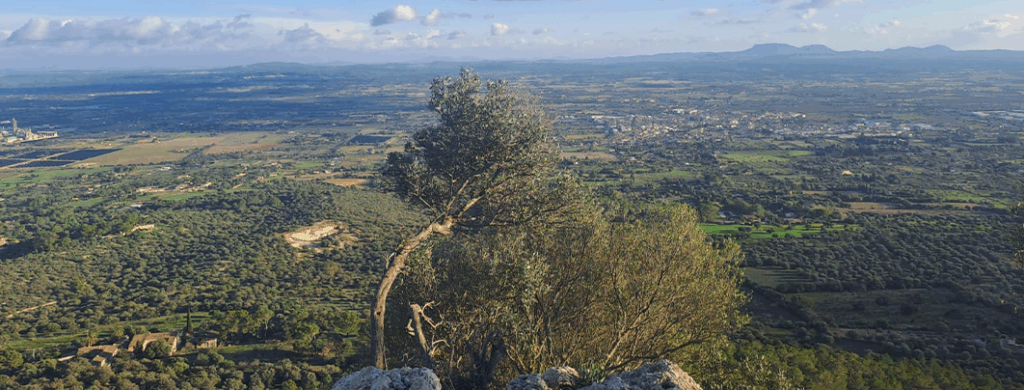
We begin the route from the Binissalem train station or, if preferred, from the Can Arabí car park. This journey allows us to contemplate some of the finest views of Binissalem and the entire region, providing access to one of the most significant heritage elements in terms of both history and nature: the viewpoint of Sa Panada.
From the views of Coll de’n Simonet, Puig dels Bous and the viewpoint itself we will contemplate unique views of the municipality and its surroundings.
A route with a distance of less than 7 kilometers, with a high elevation gain and loss and moderate technical difficulty.
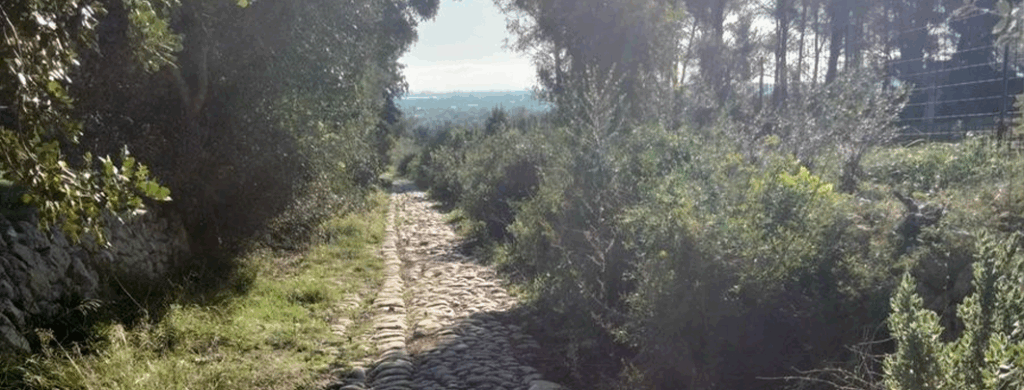
The route is simple and forms a pleasant walk around Binissalem in the direction of Alaró along the old road.
Our journey commences at the Binissalem train station, heading towards the camí vell del Raiguer. Just over a kilometer away, we encounter a junction known as the Pota del Rei (straight ahead leads to Can Arabí, to the right to Lloseta, and to the left towards the Camí Romà and Alaró). We proceed towards the Camí Romà, which we access after several kilometers along the camí vell des Raiguer, offering splendid panoramic views of Binissalem with its church and imposing bell tower to our left; we then pass by the houses of Can Cabrit (comprising the Torre de Can Moranta and Can Cabrit), which form a kind of medieval-era farmhouse.
After passing this farmhouse, we take a turn to the right, which after a few meters of elevation reveals the start of the Camí Romà. We must follow its path, and it is only later that we encounter the paved area that allows us to relive its historical splendor in full. At the entrance of the path, stone bollards prevent the passage of vehicles, making the route a perfect place for a stroll in an environment that combines history, heritage, and nature.

This route, just over 4 kilometers one way (8 kilometers round trip), connects the towns of Binissalem and Lloseta via the old camí des Raiguer.
We depart from the Binissalem train station in the direction of Can Arabí. At the Pota del Rei, located at the intersection between the camí de Can Arabí and the camí des Raiguer (which leads to both Alaró and Lloseta), we turn right on this occasion towards Lloseta.
This road, little frequented by vehicles and primarily used by cyclists and hikers, leads through the outskirts to Lloseta. Along the way, we can witness the views offered by the possessió of Morneta…
Another alternative is to leave the center of Binissalem via the Camí de s’Aigua to continue along Carrer de sa Goleta, thus connecting later with the Camí d’es Raiguer.
For our return, once we have reached Lloseta, we can either retrace the same path or take the pedestrian route that extends from Lloseta to the Foro de Mallorca, and from there, back to Binissalem.
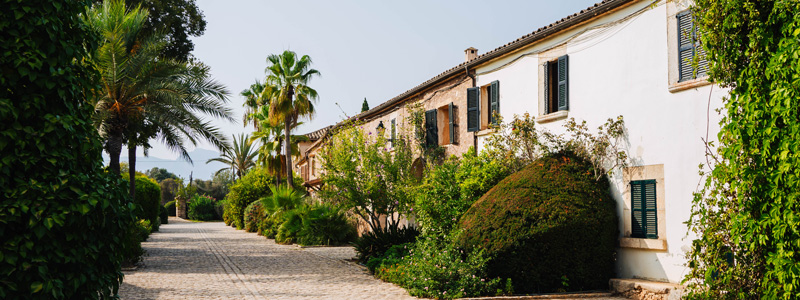
This route through the southern area of Binissalem runs along the camí de Biniagual. This is the path that connects Binissalem with this small farmhouse of Muslim origin which, over the centuries, has become a benchmark for the vineyard and heritage landscape of the area.
A route that passes through vineyards and landscapes full of beauty.
A journey of just over 6 kilometers that directly connects the two locations. It is impossible to get lost.
There are other, more extensive alternatives departing from Binissalem towards Lloseta via a pedestrian path that runs to the Camí de la Font Ufana (which begins at the Foro de Mallorca roundabout). This circular route is longer than the previous one and traverses vast areas of vineyards (Sa Cabana) until connecting with the Camí Vell de Muro, where we turn right towards Consell and Santa Maria to arrive, amidst groves, at Biniagual.
During the journey, we find various alternatives, such as the Camí de Son Roig or the Venda de Can Garriga, where we discover extraordinary places like Sa Vinyota.
Another aspect offered by this route through the southern area of Binissalem is the possibility of continuing to other municipalities such as Sencelles (once we have reached Biniagual) or Consell (if we complete the entire circular route). All this via secluded paths, with almost no vehicle traffic, allowing us to enjoy peaceful and beautiful natural landscapes.


